A step-by-step guide to planning a commercial asphalt paving project, coordinating property access and understanding the main stages of construction.
A commercial asphalt paving project involves more than placing a new layer of pavement. For property managers, the work also affects parking availability, customer access, tenant operations, deliveries and day-to-day property management.
Understanding the asphalt paving process can help property managers prepare for construction, review project proposals and coordinate with the paving provider before work begins. It can also make it easier to recognise important decisions during site preparation, asphalt placement and final handover.
Whether a commercial property needs new pavement or improvements to an existing parking lot, the appropriate construction approach depends on the pavement’s condition, site requirements, traffic and project specifications.
What Happens Before a Commercial Asphalt Paving Project Begins?
Successful project planning starts before construction equipment arrives. Property managers should understand the proposed work, confirm responsibilities and prepare the site for construction-related access restrictions.
Site Assessment and Written Scope
The initial site assessment helps establish what work may be appropriate for the property. A site review may consider:
- The existing asphalt surface and visible deterioration.
- The size and layout of the paved area.
- Vehicle traffic, including deliveries and heavier commercial vehicles.
- Drainage patterns and areas where water collects.
- Existing pavement edges, curbs and transitions.
- Access points, loading areas and pedestrian routes.
- The condition of the underlying pavement or base, where it can be assessed.
- Existing markings, designated parking spaces and other site features.

The proposed work may involve new asphalt construction, an overlay, milling and resurfacing, or more extensive pavement removal and reconstruction. These approaches are not interchangeable. The suitable option depends on the existing surface, underlying conditions and project requirements.
Before approving a proposal, request a written scope that explains what is included.
The Asphalt Pavement Alliance Construction Checklist for Parking Lots explains that construction quality should be considered throughout the project, from the subgrade and base layers through the paving process.
Plan Parking, Tenant and Customer Access
A commercial parking lot can remain an important part of business operations while paving work is being planned. Closing or restricting the entire area without a suitable access plan may create avoidable disruption.
Before construction starts, discuss how the property will operate during each stage. Consider preparing an access plan that identifies:
- Areas that will be closed during construction.
- Parking spaces that may remain available.
- Temporary entrances and exits.
- Delivery and loading access.
- Pedestrian routes and temporary walkways.
- Emergency vehicle access.
- Accessible parking arrangements and routes.
- Locations for temporary construction signs and barriers.
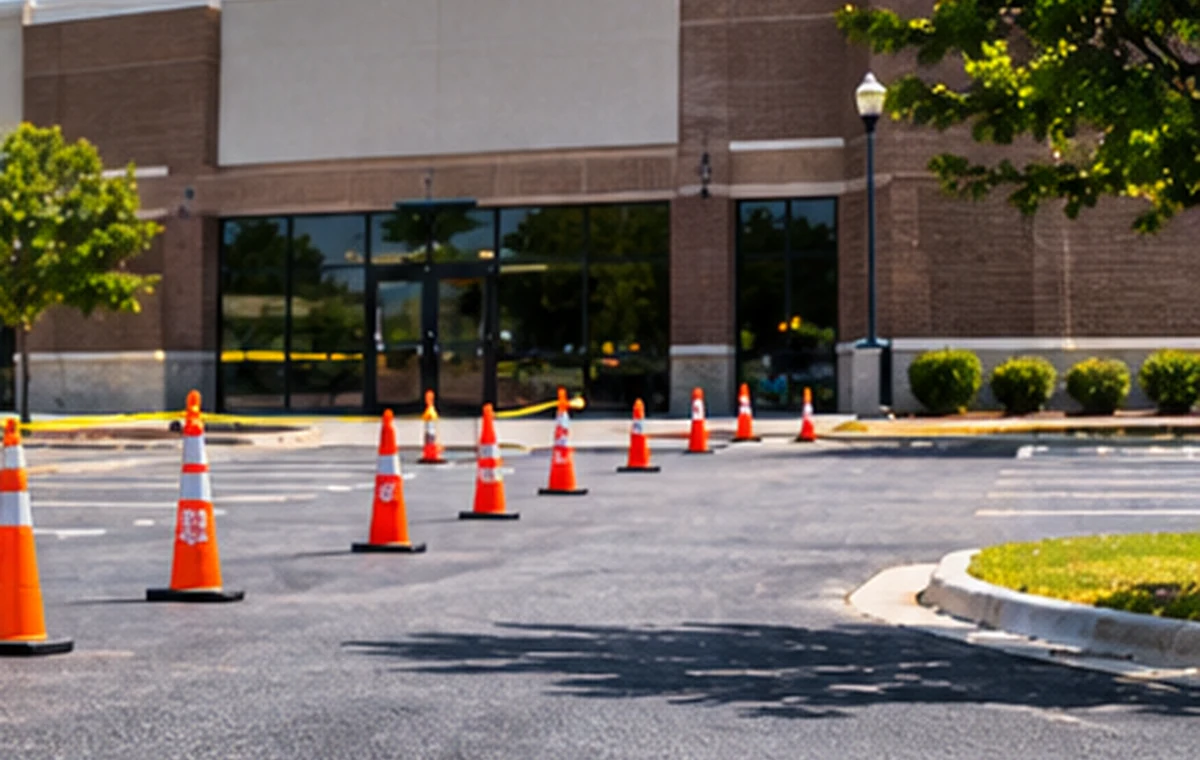
For larger properties, work may be divided into sections so that selected areas can remain available while other areas are under construction. Whether this is practical depends on the layout, project scope, available access and construction sequence.
Property managers should coordinate notices with tenants and other affected parties. Notices can explain the planned work areas, expected restrictions, alternative parking arrangements and the appropriate contact for project questions.
Accessible routes and parking arrangements deserve particular attention. The U.S. Department of Justice provides official guidance on accessible parking spaces, including access aisles and routes to accessible entrances.
Review ADA Accessible Parking Guidance ↗This article is not an ADA compliance determination. Applicable requirements should be reviewed for the specific property and work plan.
The Commercial Asphalt Paving Process: Step by Step
The exact construction sequence depends on whether the project involves new pavement, an overlay, milling or reconstruction. The following stages describe common elements that may be included in a commercial asphalt paving project.
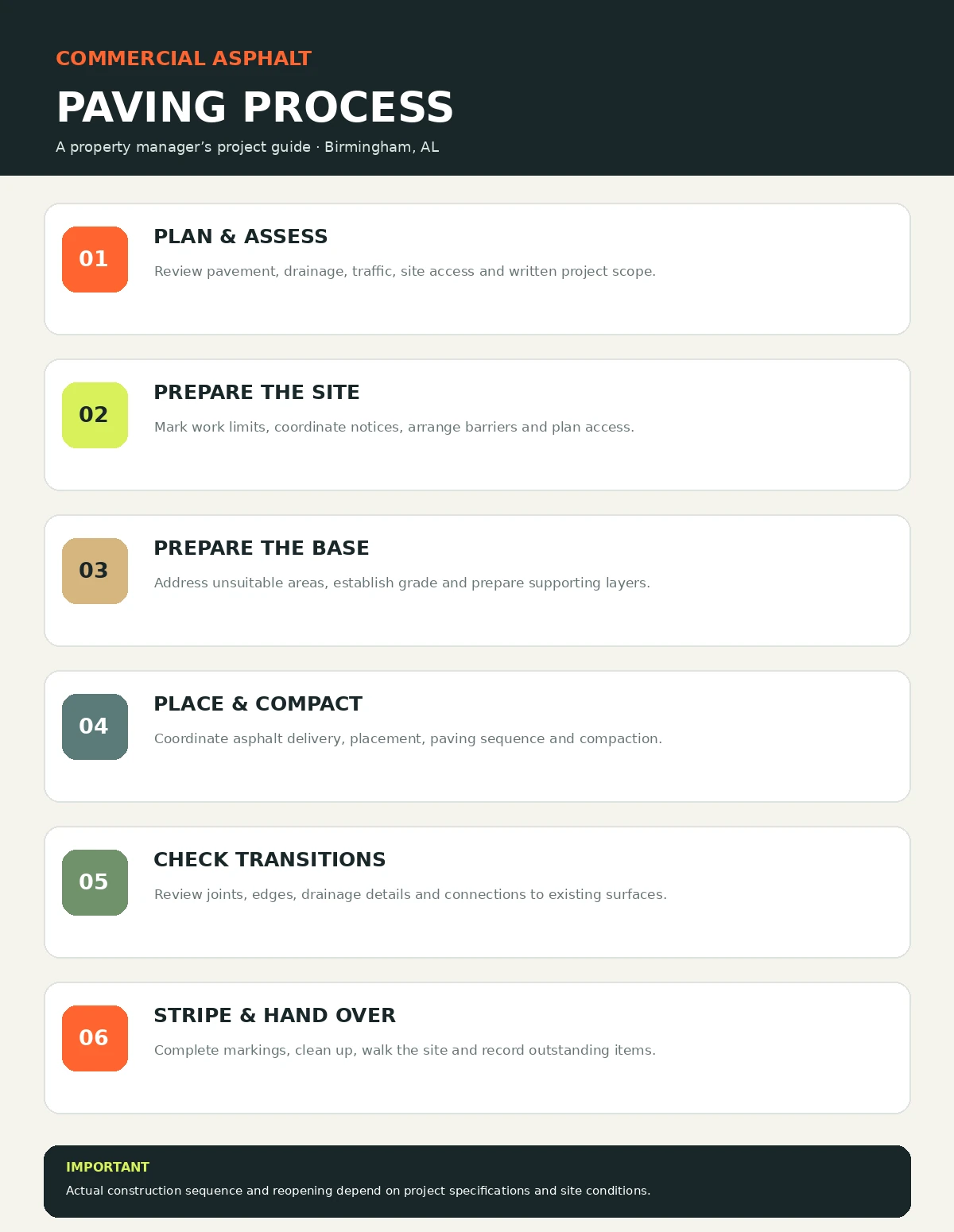
1. Layout, Marking and Work-Area Preparation
Before physical construction begins, the project limits and work sequence should be understood by the people coordinating the site. This stage may involve:
- Identifying the areas scheduled for construction.
- Marking work boundaries and paving sections.
- Confirming access restrictions.
- Positioning suitable signs, cones and barriers.
- Coordinating vehicle removal from affected areas.
- Confirming delivery and equipment access.
- Reviewing pedestrian and emergency routes.
Property managers should compare the marked work areas with the approved project scope. If an area appears to be included or excluded incorrectly, clarify the difference before construction proceeds.
2. Milling, Removal or Surface Preparation
The next stage depends on the condition and design of the existing pavement. For an overlay project, the existing asphalt surface may need milling or other preparation so the proposed new pavement can meet the intended elevations and transitions.
For reconstruction, sections of the existing pavement may need to be removed to reach the material that requires evaluation or improvement.
- Milling selected pavement areas.
- Removing deteriorated asphalt.
- Cleaning loose material and debris.
- Addressing damaged areas identified in the scope.
- Preparing the existing surface for the proposed treatment.
- Checking transitions around entrances, curbs and drainage structures.
Not every project requires complete removal of the existing asphalt. The proposed approach should be explained in the written scope. Property managers should ask how unexpected deterioration will be documented and approved if additional removal or preparation becomes necessary.
3. Subgrade and Aggregate Base Preparation
The pavement foundation is an important part of the construction process. The subgrade and aggregate base provide support for the asphalt pavement structure.
Depending on the project design and site conditions, preparation may involve removing unsuitable soil or unstable material, correcting areas that need additional support, placing or adjusting aggregate base material, establishing the required grade and elevations, compacting prepared materials, and reviewing drainage and the intended surface profile.
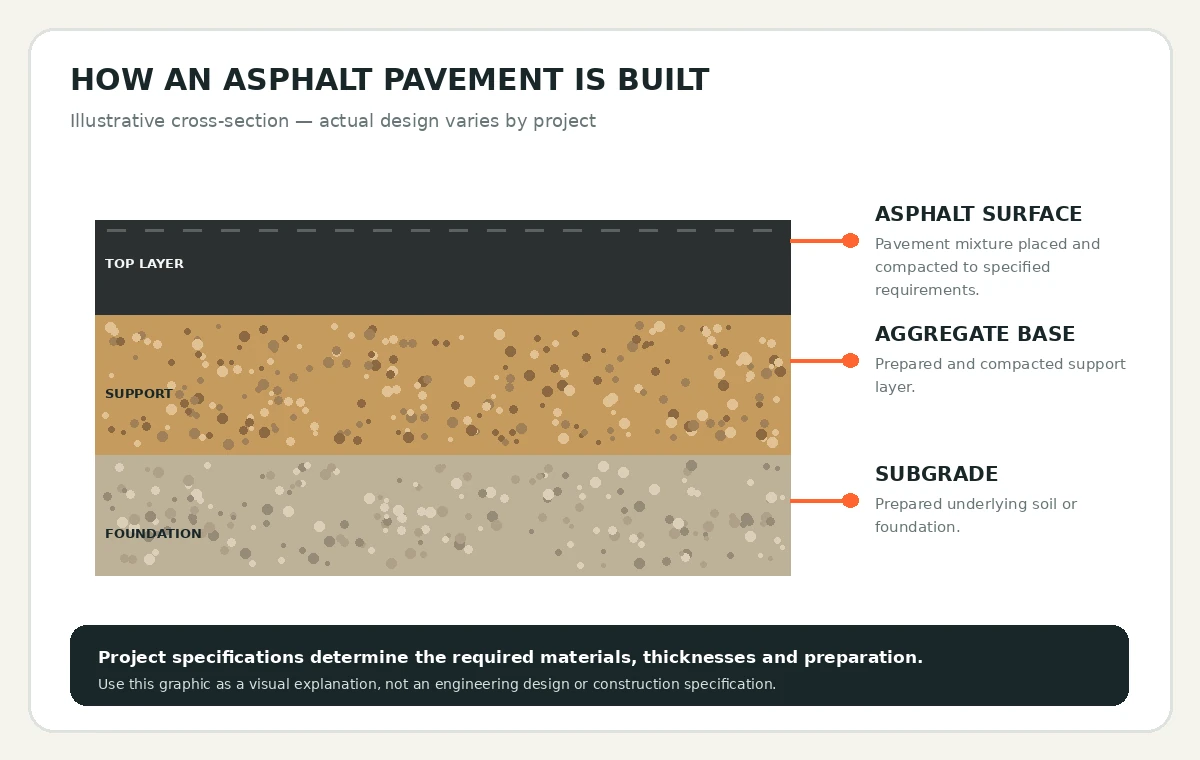
The Asphalt Pavement Alliance identifies stable subgrade and properly prepared base layers as important parts of parking lot construction. Its base-preparation guidance discusses checking foundation support and the condition of prepared layers before paving.
For a property manager, an important question is not simply whether the surface looks ready. It is whether any soft, unstable or unsuitable areas identified during preparation have been addressed in accordance with the project specifications.
If unexpected ground conditions are discovered, ask for the proposed corrective work, its effect on the project scope and any associated cost or schedule change to be documented.
4. Asphalt Mix Delivery, Placement and Compaction
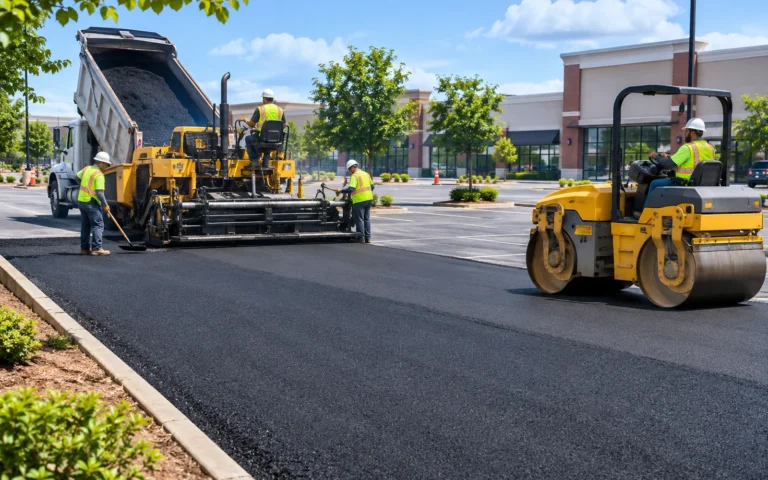
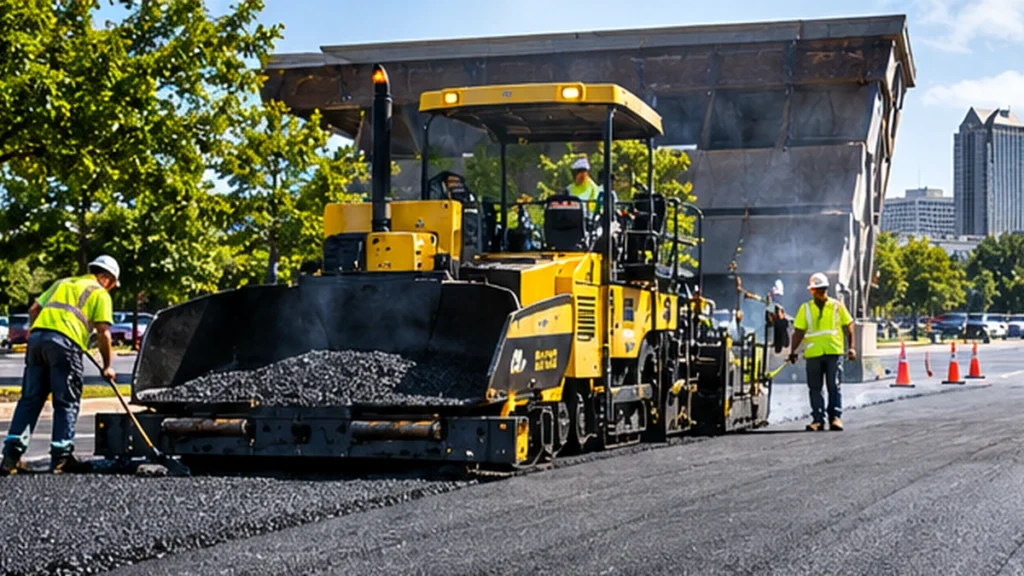
After the prepared surface is accepted for paving, the selected asphalt mixture can be delivered and placed according to the project requirements. The paving operation may involve coordinating asphalt deliveries with the work sequence, checking delivered material against the specified project mixture, positioning paving equipment, placing asphalt across the prepared area, maintaining the intended sequence and compacting the newly placed asphalt with appropriate rollers.

Compaction is an important part of asphalt construction. It reduces air voids in the asphalt mixture and helps create the density needed for pavement performance. The Asphalt Paving Handbook’s compaction guidance explains the role of rollers after asphalt placement and the relationship between adequate compaction and pavement performance.
Property managers do not need to determine technical compaction values themselves. Instead, they should confirm that the project specifications identify the relevant quality-control requirements and how the paving provider will address them. Where testing or inspection records are part of the agreement, confirm who is responsible for arranging and supplying those records.
5. Tie-Ins, Drainage Details and Surface Transitions
Once asphalt is placed, attention should also be given to the points where the new pavement meets existing site features. These may include existing pavement sections, driveway entrances, curbs and concrete surfaces, drainage inlets, utility covers, loading areas and connections between paving sections.
Poorly coordinated transitions or unresolved drainage details can create practical issues even when a large paved area looks complete. The finished pavement should follow the intended grading and drainage design. Areas that retain water or appear to direct runoff toward an unintended location should be brought to the attention of the project team.
6. Striping, Cleanup and Final Walk-Through
After paving and the required surface preparation or waiting conditions specified for the project, finishing work may include pavement markings and cleanup. Depending on the agreement, this stage can cover:
- Repainting parking stall lines.
- Restoring directional arrows.
- Re-establishing crosswalks.
- Marking designated parking areas.
- Restoring fire-lane or loading-zone markings where applicable.
- Reviewing accessible parking spaces and access aisles.
- Removing construction debris and temporary materials.
- Completing a final site walk-through.
Parking markings should be coordinated with the approved layout and applicable requirements. For additional information about this stage, review the site’s Parking Lot Striping information.
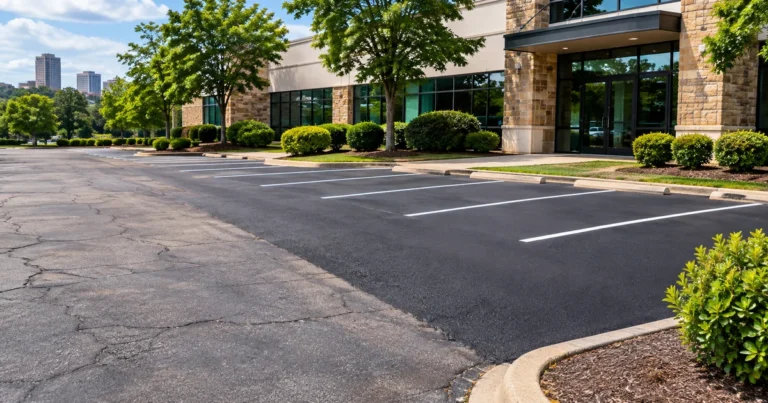
Property managers should compare the finished work with the agreed scope and identify visible items that need clarification or follow-up before the project is formally closed.
What Property Managers Should Monitor During the Work
A property manager does not need to supervise every technical operation. However, maintaining clear communication and keeping records can help the project stay aligned with the approved scope.
If additional work is proposed, ask for a written change description. It should explain the location, reason, proposed corrective action and any impact on the approved project cost or schedule. Avoid relying only on verbal instructions when a change affects the agreed scope.
What Can Affect the Project Schedule?
There is no single project duration that applies to every commercial asphalt paving job. Scheduling depends on the property, the amount of work and the conditions encountered during construction.
Ask the paving provider for a project-specific schedule that identifies the planned work sequence, access restrictions, important communication points and the person responsible for updates.
Do not assume that every parking area can reopen immediately after asphalt placement. Reopening should follow the project specifications and the paving provider’s instructions for the material and site conditions.
Questions to Ask Before Approving a Paving Proposal
Before authorising commercial asphalt paving work, property managers should understand both the construction scope and the effect on property operations.
- What work is included in the proposed project?
- Does the proposal involve new pavement, milling, an overlay or reconstruction?
- How will existing pavement and base conditions be assessed?
- What drainage or grading considerations are included?
- Which areas will be inaccessible during each phase?
- How will customer, tenant, delivery and emergency access be coordinated?
- What quality-control checks or project records are included?
- How will unexpected conditions and additional costs be approved?
- Who will provide progress updates and reopening instructions?
- What will be included in the final walk-through and handover?
Compare proposals based on the work described, not only the headline price. A clear scope makes it easier to understand differences between proposed methods and identify items that may otherwise be overlooked.
After the Asphalt Is Installed: Reopening and Handover
The project should not be considered complete simply because the visible paving operation has ended.
Before reopening affected areas, the property manager should receive clear instructions from the paving provider. The appropriate reopening conditions depend on the project specifications, asphalt mixture, weather and site conditions.
Keep barriers and access restrictions in place until the responsible project team confirms that the relevant area can be used.
Property managers should retain the approved scope, change documents, project correspondence and handover records with the property’s maintenance files.
Common Asphalt Paving Problems and How to Discuss Them
Visible construction concerns should be documented and discussed with the project team rather than diagnosed from appearance alone.
- Uneven surfaces: Record the affected location and ask how it compares with the specified finished grade.
- Visible segregation: Photograph areas where the asphalt surface appears inconsistent and ask whether the project inspector or paving supervisor has reviewed them.
- Joint concerns: Identify the location of visible seams or transitions and request a technical review where appropriate.
- Drainage concerns: Document areas where water appears to collect after rainfall and ask whether the finished grading matches the project plan.
- Pavement edge issues: Record loose, broken or unfinished transitions for review.
- Marking discrepancies: Compare the finished striping with the agreed layout and identify any missing or incorrectly positioned markings.
A photograph with a location reference and a short written description can make follow-up much easier. The appropriate response will depend on the project specification and the assessment of the responsible paving professional.
Frequently Asked Questions
What Is the Asphalt Paving Process?
The asphalt paving process generally involves project planning, site preparation, foundation or existing-surface preparation, asphalt placement, compaction, finishing and final review. The exact sequence depends on whether the project involves new construction, an overlay, milling or reconstruction.
Are All Commercial Parking Lot Paving Projects the Same?
No. Project requirements depend on the existing pavement, subgrade and base conditions, traffic, drainage, site layout and design specifications. A site-specific proposal should explain the recommended approach.
Does Every Asphalt Paving Project Require Full Pavement Removal?
No. Some projects may use an overlay or milling and resurfacing approach, while others may require more extensive removal and reconstruction. The suitable method depends on the existing pavement and project assessment.
Why Is Base Preparation Important?
The subgrade and aggregate base provide support for the asphalt pavement structure. Unstable or unsuitable areas may need corrective work before the asphalt is placed. The project specifications should explain the preparation requirements.
Why Is Asphalt Compaction Important?
Compaction densifies the asphalt mixture and helps reduce air voids. Appropriate compaction is an important factor in pavement strength, stability and performance.
Can a Commercial Parking Lot Remain Partly Open During Paving?
It may be possible to phase the work so that selected areas remain available. Feasibility depends on the lot layout, work sequence, safety arrangements and project requirements. Access planning should be agreed before construction starts.
When Can a Newly Paved Parking Lot Reopen?
The reopening decision depends on the project specifications, material, weather and site conditions. Follow the paving provider’s instructions rather than assuming a universal waiting period.
Discuss Your Commercial Asphalt Paving Project
Understanding the commercial asphalt paving process can help you prepare better questions, review project proposals and coordinate the work around your property’s operating needs.
For more information about commercial asphalt paving in Birmingham, Alabama, visit our Commercial Asphalt Paving service page.
Project scope, service coverage and availability can be confirmed during the inquiry.- Asphalt Pavement Alliance — Construction Checklist for Parking Lots
- Asphalt Paving Handbook — Base Preparation for New Asphalt Pavements
- Asphalt Paving Handbook — Compaction
- U.S. Department of Justice — Accessible Parking Spaces
This article provides general project-planning information. It is not an engineering specification, construction contract, site assessment or legal compliance determination. Project requirements should be confirmed with qualified professionals and the applicable project documents.