A practical pre-project guide to budgets, approvals, scope decisions and property operations.
Planning a commercial asphalt paving project involves more than choosing a date and requesting a price. Property managers also need to define the property’s needs, understand what the proposed work includes, secure internal approvals, compare contractor proposals and prepare for the effect construction may have on daily operations.
For offices, retail centers, industrial sites and multi-tenant properties in Birmingham, Alabama, a clear plan can make decisions easier and reduce avoidable uncertainty. This guide focuses on the decisions to organize before a project is approved. It is not a step-by-step description of paving operations; for the construction sequence, see our commercial asphalt paving process guide.
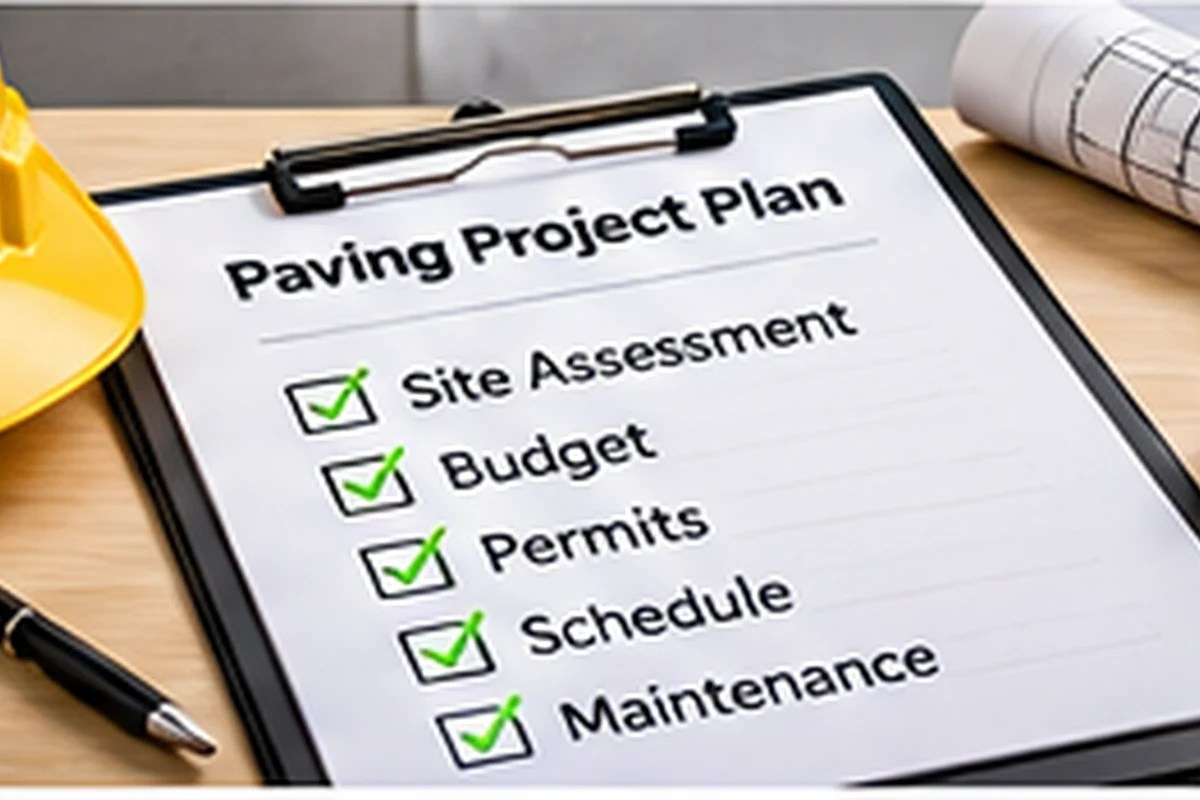
Before approving commercial asphalt paving, make sure the scope, budget assumptions, property requirements, accessibility review, contractor responsibilities and communication plan are documented in writing.
1. Define the Property’s Goals Before Requesting Proposals
Start by identifying why the project is being considered. A property may need a new paved area, a broader pavement replacement, or a targeted improvement to support changing site use. The goal affects the information contractors need and the criteria you should use to compare proposals.
- Safety and usability: Identify concerns involving uneven transitions, trip hazards, standing water or unclear traffic circulation.
- Capacity and traffic: Document delivery routes, service vehicles, loading areas and locations that experience heavier use.
- Property presentation: Consider how the parking area supports customer access and the overall appearance of the property.
- Future use: Note planned tenant changes, building additions, traffic changes or layout adjustments that could affect the design.
- Asset planning: Decide whether the work is an urgent repair, a planned capital improvement or part of a longer pavement-management program.
Record the goals in a short project brief. This gives ownership, facilities staff and prospective contractors a shared starting point instead of relying on a broad request such as “repave the lot.”
2. Build a Budget That Reflects the Full Project Scope
A useful budget should reflect more than the quoted paving work. The total project allowance may need to account for site preparation, drainage-related work, access management, markings, professional review and future maintenance. The exact items depend on the property and the contractor’s written scope.
| Budget area | What to clarify |
|---|---|
| Assessment and planning | Site review, measurements, design or engineering input, testing and documentation, if applicable. |
| Surface and base work | What removal, milling, grading, base correction or preparation is included—and what is excluded. |
| Materials and installation | Specified materials, thicknesses, quantities, limits and assumptions used to prepare the proposal. |
| Drainage and transitions | Any planned adjustments near inlets, curbs, entrances, sidewalks or adjoining pavement. |
| Property operations | Temporary signs, access arrangements, tenant notices, security or other site-specific coordination costs. |
| Markings and closeout | Whether parking lines, accessible markings, cleanup, documentation and final review are included. |
| Contingency | A reasonable owner-approved allowance for conditions that cannot be confirmed until the work area is opened. |
Ask each bidder to identify allowances, exclusions and unit-price items separately. Do not compare a low base price with a higher proposal that includes additional preparation or closeout work without first reconciling the scope. If the project is part of a capital plan, confirm the funding source, approval threshold and payment schedule before signing.
3. Prepare a Clear Scope of Work and Bid Package
A request for proposal (RFP) or written bid package should give every contractor the same basic information. It does not need to prescribe technical details that should be determined by a qualified pavement professional, but it should make the owner’s expectations clear.
Include the property address, a site plan or marked aerial image, approximate work limits, known access restrictions, intended use of the paved area and a description of the outcomes you need. Attach available records such as previous proposals, pavement plans, drainage information or maintenance notes where relevant.
Ask bidders to state:
- The proposed work areas and the method or treatment being priced.
- Preparation, removal, base correction and drainage assumptions.
- Materials and technical specifications, including who is responsible for confirming them.
- Items excluded from the price and conditions that could trigger a change order.
- Project schedule assumptions, work-hour restrictions and owner responsibilities.
- How quality checks, deficiencies, cleanup and final acceptance will be documented.
- Warranty terms, if offered, including written limitations and maintenance conditions.
For a complex property, ask whether a site meeting or professional design review is appropriate before bids are finalized. The objective is to make the proposals comparable—not to select a construction method without adequate site information.
4. Compare Contractors on More Than the Lowest Price
Commercial asphalt paving can involve significant equipment, material coordination and property-specific constraints. A proposal should be evaluated for completeness and clarity as well as price. Request relevant commercial-project references and verify any licenses, insurance, qualifications or certifications that apply to the work and jurisdiction.
Does the proposal describe the work limits, preparation, materials, exclusions and closeout?
Can the bidder explain experience with properties that have similar use, traffic and operating needs?
Is there a named project contact and a clear process for updates, approvals and urgent issues?
Are insurance details, safety responsibilities, change-order steps and written terms addressed?
Check references directly and ask what the contractor was responsible for on each project. Do not assume that a photograph, online listing or broad marketing statement proves the bidder performed a particular job or holds a specific credential.
5. Review Accessibility and Local Requirements Early
Parking-lot work can affect accessible parking spaces, access aisles, pedestrian routes, slopes and connections to building entrances. Do not treat accessibility as a striping detail to check at the end of the project.
The U.S. Access Board explains that resurfacing or resealing a parking facility can constitute an alteration under the ADA Standards, while certain routine maintenance activities—such as pothole repair or surface patching—are treated differently. The applicable requirements depend on the work and facility. Review the project with a qualified accessibility professional or the appropriate authority rather than assuming that existing layouts can simply be copied back after construction. See the U.S. Access Board parking guidance and ADA.gov accessible parking information.
Permit, zoning, stormwater and right-of-way requirements can also vary by project location and scope. Before work is scheduled, ask the contractor which approvals may apply, who will obtain them and what documentation the property owner must provide. Confirm requirements directly with the relevant City of Birmingham, Jefferson County or other authority having jurisdiction; this article does not determine whether a specific permit is required.
6. Plan for Business Operations and Stakeholder Communication
Even when the construction plan is technically sound, a commercial project can create avoidable problems if the property’s operating needs are not documented. Identify the people who must be informed and the decisions that need owner approval before the start date is confirmed.
- List tenants, employees, customers, vendors, delivery partners and emergency contacts who may be affected.
- Identify critical entrances, loading areas, accessible routes and emergency access needs.
- Confirm who approves temporary closures, signs, alternate routes and schedule changes.
- Decide how updates will be distributed and who handles questions from tenants or visitors.
- Record any high-traffic dates, business events or delivery windows that should be considered.
For detailed construction phasing and access coordination, use the separate commercial asphalt paving process article. Keeping this article focused on pre-approval decisions helps avoid duplicating the construction guide.
7. Put Change Control, Quality Review and Closeout in Writing
Before signing, agree on how changes will be proposed, priced and approved. A written change-order process helps prevent informal site conversations from becoming disputed cost commitments. Specify who can authorize additional work and whether approval must be documented before the work proceeds, except where an immediate safety issue requires a different response.
Also agree on the records the owner expects at closeout. Depending on the contract, these may include the final work-area plan, material or test documentation, approved change orders, warranty information if supplied, maintenance recommendations, and a list of outstanding items. Define who will inspect the completed work and how any punch-list items will be resolved.
8. Create a Maintenance Plan Before the Project Is Finished
A new or renewed asphalt surface should be included in the property’s ongoing maintenance program. Ask the contractor for project-specific care instructions and a recommended inspection approach. Keep records of the work limits, materials, completion details and any warranty conditions so future managers can understand what was installed.
Routine care may involve cleaning, monitoring drainage, documenting new distress and arranging appropriate maintenance when needed. Sealcoating, crack treatment and pavement markings are separate scopes with their own suitability and timing considerations; they should not be added automatically without evaluating the pavement and the contractor’s recommendations. Learn more about parking lot sealcoating, asphalt repair and patching and parking lot striping on their dedicated service pages.
Pre-Project Checklist for Property Managers
Use this checklist to organize the decisions that should be resolved before authorizing a commercial asphalt paving project.
- Project goals and work limits are documented.
- Available site plans and maintenance records are collected.
- Budget categories, allowances and contingency are reviewed.
- All bidders receive the same scope information.
- Proposals, exclusions and change-order rules are compared.
- Contractor references and required documentation are checked.
- Accessibility and local approval questions are reviewed.
- Stakeholder communication responsibilities are assigned.
- Inspection, closeout and maintenance records are defined.
Frequently Asked Questions
Define the project goals, identify the approximate work areas, gather available site and maintenance records, note operating constraints and prepare a consistent scope for each bidder. A site review may be needed to confirm the work.
Ask for work limits, proposed methods, preparation assumptions, materials and specifications, exclusions, schedule assumptions, traffic and access responsibilities, change-order procedures, quality documentation and closeout requirements.
There is no reliable universal price. Cost depends on the area, existing pavement and base conditions, preparation, drainage, materials, access constraints, markings and project requirements. Obtain written, site-specific proposals with comparable scopes.
Permit requirements depend on the location and scope of work, including whether the project affects drainage, access, public right-of-way or other regulated features. Confirm requirements with the relevant local authority before scheduling work.
Yes. Resurfacing or resealing may qualify as an alteration under ADA parking guidance, which can affect accessible spaces and routes. Have the project reviewed against applicable requirements by a qualified professional or authority.
Give each bidder the same project information and compare the work limits, preparation, materials, exclusions, allowances, schedule assumptions, change-order terms, references and closeout details—not only the total price.
That depends on the layout, work limits, access needs and contractor’s site-specific plan. Discuss closures, alternate access, emergency routes and communication before approving the schedule. Do not assume every property can remain fully operational throughout the work.
Keep the signed scope, approved changes, final work limits, relevant material or test records, warranty information if supplied, completion documentation and maintenance recommendations. These records help with future budgeting and maintenance decisions.
Planning a Commercial Asphalt Paving Project?
Discuss your property’s paving needs and request an estimate for the next step.
This article provides general project-planning information, not engineering, legal, accessibility or permitting advice. Site conditions and applicable requirements should be reviewed by qualified professionals and the relevant authorities.